

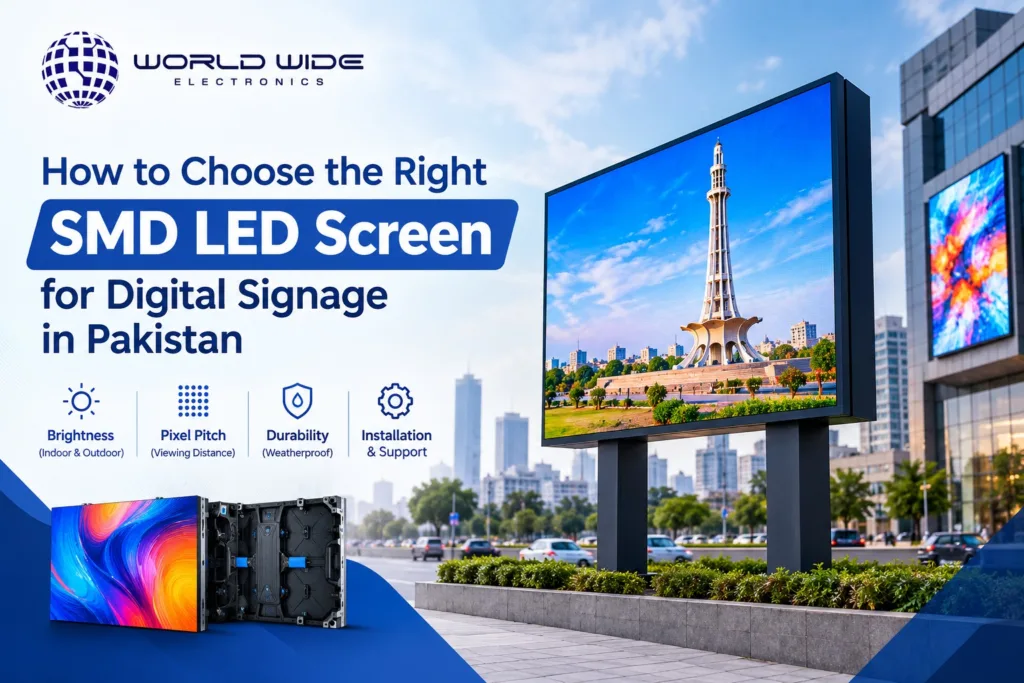



















































How to Choose the Right SMD LED Screen for Digital Signage in Pakistan


Most people don’t regret buying a screen. They regret buying the wrong one. It looks sharp in the showroom, then turns grainy from the shop entrance, or washes out under the afternoon sun on a busy road. Almost every one of these problems is decided before the purchase, in the specification.
If you’re planning digital signage in Pakistan for a shop, office, mall or event, this guide covers what to check first. We’ll use SMD LED screens as the example, because they sit behind most of the indoor and outdoor displays you see in Karachi, Lahore and Islamabad today.
What an SMD screen actually is
SMD stands for Surface-Mount Device. The red, green and blue LEDs are packed into one tiny chip and mounted straight onto the display module. Older DIP displays use separate LEDs instead, which is why SMD gives sharper images, better colour and a wider viewing angle. It’s also why SMD has become the standard for malls, wedding stages, stadiums and roadside billboards.
If you want to see the range before reading on (indoor, outdoor, rental and transparent options), the SMD LED screens page is a good place to start.
Decide where the screen will live
This is the first question because it settles most of the others. An indoor screen works in controlled light with viewers standing fairly close, so it uses a finer pixel pitch and usually runs at around 800 to 1,500 nits. An outdoor screen has to deal with direct sun, dust, rain and heat. It uses a wider pitch, 5,000 nits or more, and a weatherproof IP65 cabinet.
A storefront window that catches direct sunlight sits somewhere in between. Mention it to your supplier early, because it changes how bright the screen needs to be.
Pixel pitch: the choice that matters most
Pixel pitch is the distance, in millimetres, between two neighbouring LED pixels. A smaller pitch gives a sharper picture to people standing close. A larger pitch costs less and works well when the audience is far away.
| Pixel pitch | Best viewing distance | Typical use |
|---|---|---|
| P1.2 to P1.5 | 1 to 3 m | Control rooms, studios, boardrooms |
| P2 to P2.5 | 2 to 5 m | Meeting rooms, retail stores, malls |
| P3 to P4 | 4 to 8 m | Conference halls, indoor events, mosques |
| P5 to P6 | 6 to 15 m | Outdoor advertising, roadside displays |
| P8 to P10 | 12 m and above | Digital billboards, large outdoor screens |
Before you ask for a quote, work out how close the nearest viewer will stand and how far away the farthest one will be. That one measurement saves you from paying for sharpness nobody can see, or from ending up with a wall of visible dots.
Brightness: more isn’t always better
Outdoor screens need high brightness to stay readable in daylight. Indoors, the same brightness would be uncomfortable to look at and would only add heat. Pick the level that suits the ambient light around the screen, not the biggest number on the spec sheet. Even for outdoor screens, running at full brightness all day adds heat and shortens the life of the LEDs.
Size and structure
SMD screens are modular, so the size can follow your space. Work it out from the wall or frame you have and the viewing distance, not from the budget alone. A large screen also needs a steel structure and a proper power supply, and both should be written into the quotation so they don’t turn up as extra costs later.
Plan for load shedding and weather
Power cuts are a normal part of planning in Pakistan. An SMD screen can run on a UPS, a generator or a properly sized solar system, so ask your supplier to include backup power in the design. A stabiliser or UPS also protects the screen from the voltage swings that cause flicker.
For outdoor screens, have the cabinet seals checked before the monsoon. Rain getting into a cabinet is one of the easiest ways to damage a screen, and also one of the easiest to prevent.
Think about content before you buy
Part of the appeal of digital signage is that you can change what’s on screen without printing anything. Promotions, menus, announcements and videos can all be updated and scheduled. Most systems let you do this over LAN, Wi-Fi, a cloud platform or USB, using NovaStar or similar software.
Decide who on your team will manage the content, and ask for a short training session when the screen is installed. A good screen that nobody knows how to update ends up showing the same slide for months.
Why quotes vary so much
There is no single price for an SMD screen, because every display is built to size. Two quotes that look far apart are often quoting different things. The price depends on:
- Pixel pitch
- Indoor or outdoor specification
- Screen size in square feet
- LED brand and components
- Brightness and refresh rate
- Cabinet type and control system
- Steel structure and mounting
- Installation complexity and project location
When you compare quotes, put them side by side and check that each one covers the same pitch, brightness, controller, structure and installation.
Installation and after-sales support
A reliable supplier doesn’t just deliver boxes. The process should include a consultation, a site survey, a system design, installation, calibration, testing with staff training, and support afterwards. If a supplier skips the site survey, be careful. That’s where viewing distance, power supply and mounting problems are caught.
After installation, a little care goes a long way. Clean the screen with a soft cloth and a non-abrasive cleaner, keep power and data connections secure, and update the controller software when new versions come out. A commercial SMD screen that is well looked after can run for up to 100,000 hours under recommended conditions.
Mistakes to avoid
- Choosing by price per square foot alone, without checking pixel pitch and brightness.
- Ignoring viewing distance until the screen is already installed.
- Using an indoor screen where an outdoor one is needed.
- Leaving out backup power, the steel structure or installation from the budget.
- Having no plan for who updates the content.
Frequently asked questions
Can an SMD screen run during load shedding?
Yes. It can run on a UPS, a generator or a properly sized solar system. Your supplier should advise on backup power while designing the screen.
Are outdoor SMD screens waterproof?
Outdoor screens use IP65-rated cabinets that protect against rain, dust and heat. The seals should still be checked before the monsoon.
Can I update the screen content remotely?
Yes. Most systems allow updates over LAN, Wi-Fi, a cloud platform or USB.
Final thoughts
A good display comes down to a handful of decisions: where it will be installed, how far people will stand from it, how bright it needs to be, and who will look after it. Get those right and the rest is straightforward. For a wider look at how businesses use screens for advertising and customer communication, read this guide to digital signage in Pakistan. If you already know what you need, you can compare SMD LED screen options and request a quotation from World Wide Electronics on 0331 5575501.